Luckin Targets Starbucks With Premium Flagship in Shenzhen
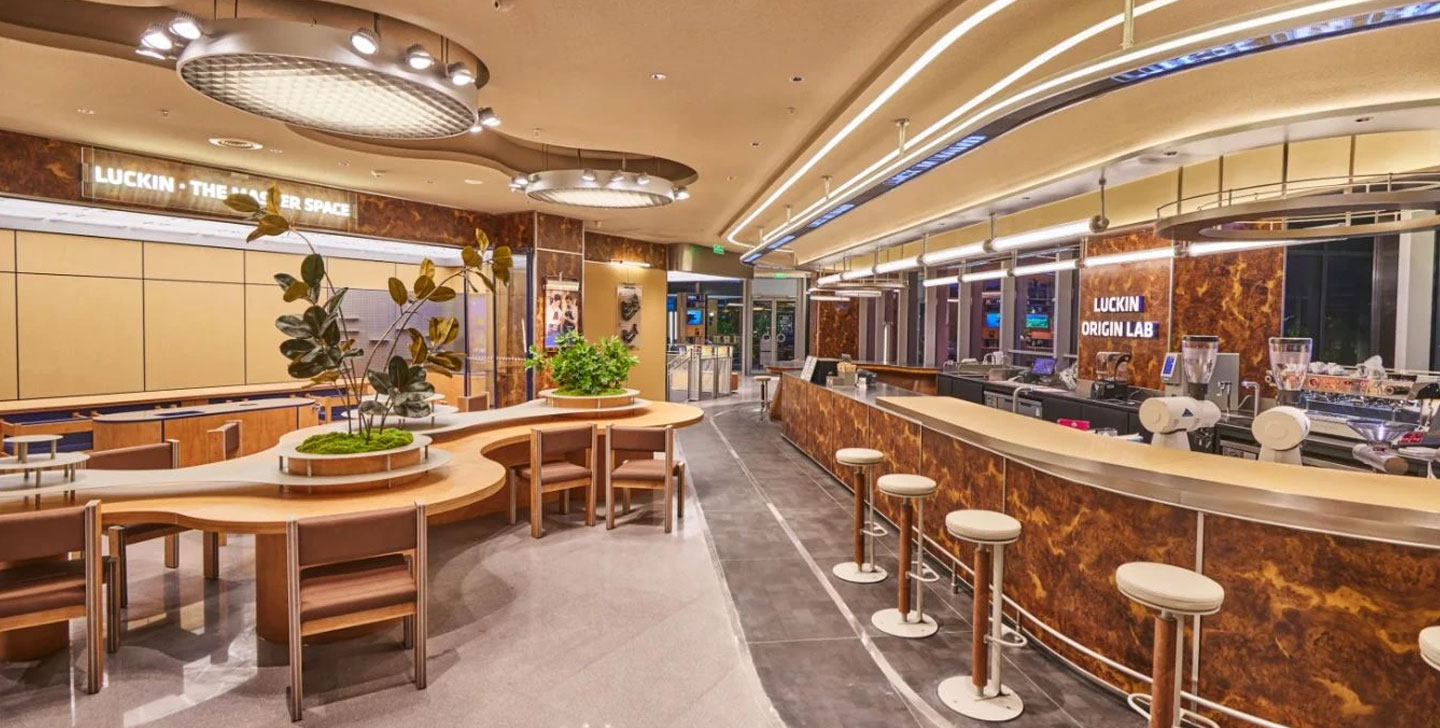
Luckin Targets Starbucks With Premium Flagship in Shenzhen
Luckin Coffee is moving upmarket in China with the launch of a premium flagship store in Shenzhen, taking a more direct run at Starbucks’ higher-end positioning as competition tightens across the country’s fast-changing coffee scene.
The new site, branded the Luckin Coffee Origin Flagship, is a two-floor store in Shenzhen near the Hong Kong border. It is a clear departure from Luckin’s original playbook, which centered on budget-priced coffee sold through compact locations and an app-first ordering model. That low-cost, high-volume strategy helped Luckin expand rapidly and overtake Starbucks in China by store count. Now, the company is signaling it wants to compete not only on convenience and price, but also on experience, product storytelling, and premium cues that have traditionally favored Starbucks.
A controlled shift toward premium
The Shenzhen flagship is designed around “origin,” an approach familiar to specialty coffee consumers and closely associated with Starbucks’ own premium branding. Rather than focusing on basic, low-priced drinks, the new store highlights sourcing and preparation. Customers can choose beans from places such as Brazil, Ethiopia, and China’s Yunnan province, aligning with the provenance-driven framing used by Starbucks and other global coffee brands to justify higher prices and a more curated experience.
Pricing is still described as only modestly higher than Luckin’s typical $1 to $2 Americanos and lattes, but the product mix is different. The store offers more pour-over and cold brew options and introduces specialty items designed to travel on social media. Chinese posts about the launch have highlighted drinks such as a tiramisu latte topped with a pastry, and early demand appears strong, with some users reporting wait times of one to three hours during the soft launch period.
The store’s size also matters. At around 420 square meters, it is a branding statement, not just another unit in a large chain. Starbucks has used this kind of format as a halo product, most visibly with Reserve Roasteries meant to showcase premium coffee, in-store theater, and a destination-style experience.
Starbucks faces more pressure in China
Luckin’s move comes as Starbucks navigates a more crowded and price-sensitive market. Coffee has expanded quickly in China, historically a tea-oriented market, and a wave of domestic competitors has normalized lower price points. Chains and boutique cafes often sell drinks for far less than Starbucks, forcing the company to compete in an environment where consumers have abundant alternatives and less willingness to pay a sustained premium.
Starbucks is also reshaping its China strategy. The company expects to close a deal in the spring to sell 60% of its China business to Boyu Capital while retaining 40%. When the plan was announced, Starbucks said it valued the China business at $13 billion, including future licensing fees. The decision underscores both the scale of the opportunity and the intensity of the pressure in a market where growth is increasingly costly.
On performance, Starbucks has pointed to improvement in comparable sales, but the environment remains challenging. Starbucks has just over 8,000 stores in China. Luckin’s footprint is far larger and still expanding, with Shenzhen positioned as a milestone location for the chain’s overall store count.
Luckin’s advantage is not only price
A key differentiator for Luckin is its smartphone ordering model, which allows customers to select, pay, and pick up with minimal friction. That structure helps the company build repeat behavior and maintain a direct channel to users through its app. In China’s consumer internet vernacular, this is often described as building “private traffic,” meaning a proprietary audience that can be engaged repeatedly through notifications, promotions, and targeted offers, rather than relying solely on foot traffic and walk-in ordering.
This system is also well-suited to fast promotional cycles and limited-time campaigns. Luckin has leaned heavily on collaborations and timed launches to create bursts of attention and push reordering. Partnerships with well-known consumer brands and popular culture properties have helped it stay top-of-mind, especially among younger customers who value novelty and social shareability alongside price.
The premium flagship fits that pattern in a different form. Even if the store remains a single location, it can still function as a marketing engine, generating content, driving foot traffic, and boosting brand lift that benefits the broader network.
A comeback that still shapes the brand
The flagship launch also lands against Luckin’s corporate history. After the company disclosed fabricated sales tied to 2019 results, it was forced to delist from Nasdaq in 2020. Yet it continued operating across China, kept its name and logo, and rebuilt momentum through rapid execution, store expansion, and disciplined growth. Its shares still trade over the counter in the U.S., and management has previously hinted at a possible future U.S. relisting, without providing a timeline.
Financially, Luckin has reported strong revenue growth at its self-operated stores, reinforcing that its rebound has been driven by operational scale rather than a narrow turnaround story.
Global expansion adds another dimension
Luckin is also pushing overseas. The company opened its first U.S. stores in New York City last summer and has continued adding locations there. It also has a growing presence in Singapore and jointly operated stores in Malaysia. Those footprints are still small relative to its China base, but they signal an intent to export its app-driven model and build brand recognition beyond the domestic market.
What the Shenzhen flagship signals
The Shenzhen flagship does not mean Luckin is abandoning budget coffee. It looks more like a test of whether the company can raise its premium ceiling while protecting its mass-market core. If it succeeds, Luckin gains more pricing power, stronger brand credibility, and a better counter to Starbucks’ experience-led differentiation. If it does not, the store can still serve as a high-visibility experiment that informs product development and marketing across a network built for speed, convenience, and high-frequency ordering.
Either way, the message is clear: in China’s coffee market, the competition is no longer only about store count. It is also about habit formation, product novelty, and who can win the premium narrative without losing scale.
